Olive: A Practical Evaluation of a Fluid Monoline Font for Design Projects
Selecting a typeface is a decision that influences readability, brand perception, and overall design cohesion. Among the many options available, Olive has attracted attention as a fluid monoline font that combines a handmade origin with polished execution. This article offers a balanced evaluation of Olive, helping you determine whether it aligns with your specific project goals, workflow, and aesthetic preferences. We will explore what makes Olive distinctive, where it performs well, the tradeoffs involved, and practical considerations for making an informed choice.
What Is Olive?
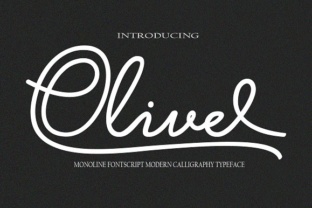
Olive is a fluid monoline font developed through a meticulous handmade process and then fine-tuned to achieve a consistent, refined outcome. The term monoline refers to a typeface where all strokes have a uniform thickness, with no variation between thick and thin lines. This characteristic gives Olive a clean, even appearance that works well in various contexts. The fluid quality describes the smooth, uninterrupted flow of the letterforms, which appears natural and organic rather than rigid or mechanical.
Because Olive is handmade, each glyph carries subtle nuances that a purely algorithmic design might lack. These nuances contribute to the font's personality without sacrificing the uniformity expected in a monoline typeface. The fine-tuning stage refines these initial hand-drawn shapes, ensuring that spacing, alignment, and consistency meet professional standards. The result is a font that balances artisanal character with technical reliability.
Why Consider Olive? Potential Motivators
Several factors might draw your attention to Olive, depending on the nature of your project and your aesthetic leanings. Understanding these motivators helps clarify whether the font is a strong candidate for your needs.
- Clean and cohesive aesthetics: The monoline structure provides a uniform stroke weight, which can create a sense of harmony across headings, body text, and other elements. This consistency is often valued in minimalist or modern design schemes.
- Handmade origin with refined execution: If you are seeking a typeface that offers human warmth and subtle irregularities without sacrificing polish, the combination of hand-drawn beginnings and fine-tuning may appeal to you.
- Versatility in weight and scale: Monoline fonts can perform well at both small and large sizes, making them candidates for logos, headlines, signage, and even extended reading environments if legibility holds up.
- Distinctive yet neutral character: Olive's fluid quality gives it a soft, approachable feel that is not overly ornamental. This can suit projects where the typeface supports the message without dominating it.
Benefits and Tradeoffs of Using Olive
Like any design choice, adopting Olive involves a set of advantages and potential drawbacks. Evaluating these tradeoffs against your specific requirements is key to a balanced decision.
Benefits
- Visual clarity: The uniform stroke thickness reduces visual noise, which can improve legibility in certain applications, especially at larger sizes.
- Brand distinctiveness: A handmade-derived monoline font can help your branding stand out from more generic or corporate typefaces while still maintaining professionalism.
- Consistency across media: Because the font does not rely on variable stroke contrast, it often reproduces well across print, screen, and signage without losing its essential character.
- Adaptability: The fluid forms can be paired with both serif and sans-serif companions, offering flexibility in type hierarchies.
Tradeoffs
- Limited expressiveness in small sizes: Monoline fonts can sometimes lack the nuance needed for prolonged reading at very small sizes, especially if the stroke weight is too heavy or too light.
- Less contrast variation: If you rely on thick-thin transitions to create visual rhythm or hierarchy within a single weight, a monoline approach may feel monotonous over extended passages.
- Potential for overuse: Because monoline fonts are trending in certain design circles, there is a risk that your project may look generic if the font is not paired thoughtfully with other design elements.
- Handmade quirks may not suit all contexts: Some projects require absolute geometric precision; the subtle irregularities in Olive may be perceived as imperfections in very formal or technical environments.
Key Considerations and Expectations
Before integrating Olive into your workflow, it is worth examining several practical dimensions that affect its real-world performance.
Legibility and Readability
Olive's monoline structure generally supports good legibility at display sizes, where each letterform is clearly delineated. For body text, the outcome depends on the specific weight, letter spacing, and line height you choose. Testing the font in your intended reading environment is advisable—especially for longer documents, where the lack of contrast may cause eye fatigue if the stroke weight is not optimized.
Licensing and File Formats
Ensure that the license for Olive aligns with your usage. Check whether it covers web embedding, app integration, or commercial print runs. Also confirm the availability of required file formats (OTF, TTF, WOFF, etc.) for your production pipeline.
Language Support and Character Set
If your project requires extended Latin characters, diacritics, or non-Latin scripts, verify that Olive includes the necessary glyph coverage. The handmade nature of the font may limit the character set unless the designer has expanded it intentionally.
Pairing with Other Fonts
Olive works well as a display face or for short to medium-length texts. When combining it with a secondary typeface, look for fonts that offer complementary proportions and a different contrast dynamic. A serif with moderate stroke variation or a geometric sans-serif can create a balanced hierarchy without clashing.
Where Olive Is a Strong Fit
Understanding the contexts in which Olive performs best helps you decide whether it is the right tool for your project.
- Logo and branding projects: The fluid yet uniform letterforms can produce a distinctive wordmark that remains legible across sizes and media.
- Headlines and titles: At large sizes, the handmade details become visible, adding personality without overwhelming the design.
- Minimalist and modern interfaces: Olive pairs naturally with clean layouts, where its lack of ornamentation aligns with a less-is-more philosophy.
- Packaging and product labels: The monoline structure works well when text needs to be readable at a glance, especially on small or complex packaging designs.
- Short-form editorial content: Magazine titles, pull quotes, and section headers benefit from the font's clarity and distinctive flow.
When Alternatives May Be Worth Considering
Olive is not the optimal choice for every scenario. Recognizing its limitations can steer you toward a more suitable typeface when needed.
- Extended body text: For long-form reading, a font with more pronounced contrast between thick and thin strokes often reduces fatigue and improves readability. In such cases, consider a well-crafted serif or a humanist sans-serif.
- Highly formal or technical documents: If your project demands strict geometric precision or a very neutral appearance, a purely mechanical sans-serif might better serve the purpose.
- Heavy data presentation: Tables, figures, and dense statistical information often benefit from fonts designed specifically for data, which offer clear differentiation between similar characters.
- Multi-script or character-heavy projects: If you need extensive non-Latin support or a very large glyph set, the handmade limitation may make Olive less viable compared to more comprehensive type families.
Practical Decision-Making Insights
To determine whether Olive matches your goals, consider the following framework:
- Define your primary use case. Is the font for headlines, body text, logos, or a combination? Match the font's strengths to your dominant application.
- Test in context. Place Olive in mockups at actual sizes and on the intended medium. Evaluate both legibility and aesthetic fit.
- Assess the visual tone. Does the fluid, handmade quality support the message you want to convey? For warm, approachable, or creative brands, it may be ideal. For austere or technically oriented brands, it might feel mismatched.
- Consider the pairing strategy. Plan how Olive will interact with other typefaces, colors, and visual elements. A strong pairing can mitigate the font's limitations.
- Check the technical requirements. Verify licensing, file formats, language support, and compatibility with your design software and platforms.
- Weigh the tradeoffs consciously. Accept that no font is perfect. Acknowledge where Olive may fall short and decide whether those shortcomings are acceptable for your project.
Ultimately, choosing Olive involves balancing its distinctive handmade fluidity and monoline consistency against the need for contrast and nuance in certain contexts. For projects that prioritize clean, uniform forms with a human touch, Olive offers a compelling option. For applications that demand high readability over extended text or extreme geometric precision, exploring other typefaces may be more practical.
By approaching the decision with clear criteria and realistic expectations, you can determine whether Olive aligns with your vision or whether another font would serve your purpose more effectively. The best typeface choice is one that supports your content, enhances usability, and communicates the intended tone without drawing undue attention to itself.