Sameri: A Smooth Hand Marker Brush Font for Modern Design Projects
When you are selecting a typeface for a branding project, a poster, or a social media campaign, the choice often comes down to balancing personality with readability. Many fonts lean too far toward either polished perfection or raw, uncontrolled texture. Sameri, a smooth hand marker brush font, occupies a deliberate middle ground. It was created to give a modern look and feel to your next project, but what does that mean in practice? This article examines what makes Sameri distinct, where it fits best, and how it compares with other approaches in typography.
What Sets Sameri Apart in the Brush Font Landscape
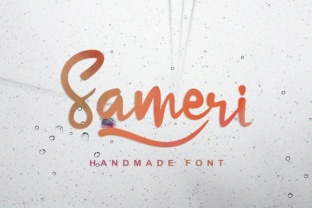
Brush fonts vary widely. Some mimic the aggressive, dry strokes of a paintbrush on rough paper, while others simulate the consistent width of a felt-tip marker. Sameri falls into the latter category but adds careful refinement. The strokes are smooth, meaning the edges lack the harsh, irregular fraying common in many hand-lettered fonts. This gives it a cleaner appearance while still retaining the human, imperfect quality of something drawn by hand.
The "hand marker" aspect is key. Unlike digital fonts that feel mechanically perfect, Sameri carries subtle variations in stroke thickness, curve angles, and letter spacing. These variations are not random; they are designed to feel natural without distracting from the content. For designers who want the authenticity of hand lettering without sacrificing legibility, Sameri offers a practical middle path.
Another distinct feature is its consistent baseline and x-height. Many brush fonts have wildly varying character heights, which can make body text or even short headlines difficult to read. Sameri maintains a more uniform structure, which broadens its use cases beyond just display text. This does not mean it is devoid of character, but rather that the character is controlled.
Versus Rough, Textured Brush Fonts
Rough brush fonts are popular for grunge, vintage, or heavy-handed artistic projects. They often feature ink splatters, uneven edges, and distressed textures. Sameri is intentionally different. If you are working on a project that needs to feel edgy, worn, or aggressively handmade, a rougher font may serve you better. However, if you need a font that reads clearly at smaller sizes or appears in a professional context, Sameri avoids the readability problems that rough textures introduce. The tradeoff is that Sameri may not convey the same raw, unpolished energy as a distressed brush font.
Versus Clean Sans-Serif or Script Fonts
Clean sans-serif fonts like Helvetica or standard scripts like a regular cursive typeface offer ultimate predictability. They are safe choices for corporate communications or extended reading. Sameri cannot replace these for long-form body text or ultra-formal settings. Its hand-drawn nature introduces a casual warmth that might feel out of place in a legal document or a scientific journal. However, for branding, packaging, or digital media where you want to inject personality, Sameri offers an alternative that feels more approachable than a sterile sans-serif and less formal than a traditional script.
Versus Other Smooth Marker Fonts
Within the category of smooth marker fonts, Sameri distinguishes itself through the balance of stroke dynamics. Some marker fonts look like they were drawn with a consistent, flat tip, resulting in uniform lines. Sameri simulates a more natural hand pressure variation—thicker downstrokes and thinner upstrokes—without becoming exaggerated. This makes it more versatile for mixing with other typefaces or for use in multilingual layouts where letterforms need to remain distinct.
Strengths and Best-Fit Situations for Sameri
Sameri excels in projects where the goal is to appear modern, friendly, and handcrafted, but also professional. Common use cases include:
- Brand logos and wordmarks for lifestyle, food, beauty, or creative businesses
- Social media graphics and Instagram stories that need a human touch
- Product packaging, especially for artisanal or small-batch goods
- Event posters, flyers, and signage where readability from a distance matters
- Website headers and hero text that need to stand out without clashing with a clean layout
A realistic example: a specialty coffee roaster launching a new blend wants a label that feels hand-drawn but remains readable on a small bag. A rough brush font might obscure the blend name, while a standard sans-serif would feel too industrial. Sameri provides the warmth of hand lettering and the clarity needed for quick recognition. Similarly, a yoga studio designing a workshop poster could use Sameri for the main title. Its smooth strokes evoke calm and intentionality, not chaos.
Limitations and When You May Need Another Option
No single font works for every scenario, and Sameri has constraints worth considering.
- Extended body text: Because it is a brush-style font, Sameri is not ideal for paragraphs of text. Even with its smooth design, prolonged reading in a brush typeface causes fatigue. Pair it with a clean sans-serif or serif for body copy.
- Formal or corporate contexts: Law firms, financial institutions, or academic publications generally avoid hand-drawn typefaces. Sameri would feel out of place in annual reports or formal correspondence.
- Highly distressed or vintage aesthetics: If your project demands a weathered, antique, or punk look, Sameri's smoothness may be too refined. You would be better served by a font with intentional rough edges.
- Very small sizes: Although Sameri is more legible than many brush fonts, at very small sizes (below 12pt in print or 16px on screen), the hand-drawn nuances may blur. For fine print, a simpler typeface is advisable.
- Non-Latin character sets: Like many brush fonts, Sameri's design is optimized for Latin-based alphabets. If your project requires extensive Cyrillic, Greek, or East Asian characters, you may need a different solution.
Decision Factors: Is Sameri Right for Your Project?
To decide whether Sameri fits your needs, evaluate these factors:
Audience and Tone
Ask yourself who you are communicating with and what feeling you want to evoke. Sameri works well for audiences who value creativity, warmth, and authenticity. If your audience expects precision and formality, look elsewhere.
Medium
Digital screens, large format prints, and short text blocks are ideal for Sameri. If your content is primarily long-form or will be read on low-resolution devices, prioritize a font designed for extended reading.
Pairing Potential
Sameri pairs effectively with neutral sans-serif fonts like a geometric or humanist typeface. If you have an existing brand type system, test how Sameri complements it. It can serve as an accent font for headlines or a primary font for logo work, but rarely both in the same project without careful contrast planning.
Licensing and Usage
Before committing to any font, check the licensing terms. Ensure Sameri's license covers your specific use—commercial projects, web embedding, app integration, or print runs. Some brush fonts have restrictions on modification or redistribution.
Practical Comparison: Sameri in Context
Imagine two hypothetical projects to illustrate the decision process.
Project A: A local bakery wants to redesign its packaging for artisan bread. The owner wants a label that feels handmade and rustic but is still easy to read from a shelf three feet away. Here, Sameri would be a strong candidate. Its smooth strokes prevent the "homemade" look from becoming messy, and its clarity helps customers identify the bread type quickly. The alternative would be a textured brush font that might obscure small text like ingredient lists or a clean sans-serif that would look too mass-produced. Sameri strikes a practical balance.
Project B: A tech startup creating a productivity app needs a landing page that looks innovative but professional. The headline font must feel modern and approachable, but the body text must be highly readable. In this case, Sameri might work for the hero headline if paired with a neutral sans-serif for the body. However, if the startup's brand identity leans minimalist and tech-forward, a smooth brush font may still feel too casual. A better choice might be a slightly rounded sans-serif or a modern geometric typeface. Sameri is not wrong, but the fit depends on whether "handcrafted" aligns with the brand story.
Exploring Alternatives Within the Same Category
Even if you decide that a smooth hand marker brush font is right for your project, you might consider what else is available beyond Sameri. Some fonts in this category emphasize a more uniform marker stroke, while others introduce subtle texture or watercolor effects. The key differences usually come down to:
- Stroke contrast: How much difference between thick and thin parts of each letter
- Letter spacing: Tight or loose, which affects readability and tone
- Character set: Special characters, ligatures, and multilingual support
- Weight variation: Availability of light, regular, bold, or extra-bold versions
Sameri tends to sit in the moderate range on all these axes. It is not the boldest, not the lightest, not the tightest, and not the loosest. This makes it a flexible choice when you are unsure about the final application. But if you need extreme contrast or very tight spacing for a specific design, you may want to evaluate options that specialize in those directions.
Making an Informed Choice
Selecting a font is rarely about finding a single "best" option. It is about understanding the context, audience, and medium. Sameri offers a clear value proposition: smooth, hand-drawn letterforms that maintain readability and a modern feel. It is not a solution for every design problem, but for projects that benefit from approachable, human-centered typography, it is worth considering.
Before you finalize, test Sameri in your actual layout. Pair it with your chosen body font. Print it at the intended size. Show it to someone unfamiliar with the project and ask what they feel. Often, the right choice becomes obvious once you see how the font interacts with other elements.
If your project requires a rugged, distressed, or ultra-formal look, Sameri may not be the best fit. But if you need a clean, modern brush font that bridges the gap between handcrafted charm and professional polish, it is a strong, practical option that deserves a place in your evaluation process.