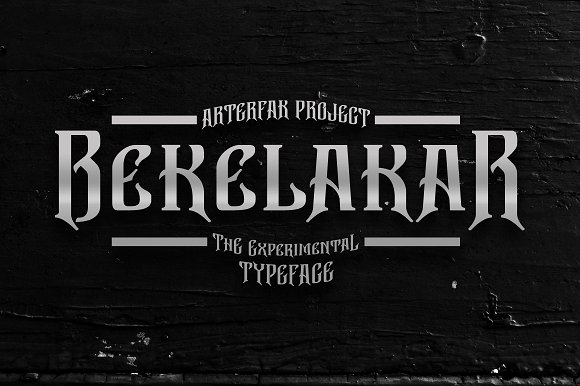
Bekelakar: A Blackletter Font Built for Atmosphere and Impact
When a design demands more than mere legibility and instead calls for raw presence, typeface selection becomes a strategic decision. Bekelakar enters that conversation as a blackletter font that deliberately pushes beyond traditional gothic forms. Its experimental letter shapes draw from hardcore, horror, and metal aesthetics, yet it avoids becoming a novelty face that works only in niche contexts. Available in Regular and All-caps styles, Bekelakar offers a nuanced tool for projects where atmosphere, tone, and visual weight matter as much as the message itself.
This article examines what Bekelakar actually delivers, where it performs best, and which professionals might find it a worthwhile addition to their type library. The focus remains on practical evaluation rather than hype.
Understanding Bekelakar's Design and Intent
Bekelakar belongs to the blackletter family, a classification rooted in medieval manuscript hands and later associated with heavy music subcultures, tattoo lettering, and horror media. What distinguishes Bekelakar from standard blackletter offerings is its willingness to experiment with proportions, stroke contrast, and character shapes. The letters are not uniform in the way a text face aims to be. Instead, they carry deliberate irregularities that give the font a hand-drawn, almost distressed quality without losing structural coherence.
The Regular style retains lowercase letters with ascenders and descenders that extend in dramatic arcs, creating a rhythm that feels both ancient and aggressive. The All-caps version compresses that energy into a more blocky, monumental form. Both styles share a common skeleton, but their applications diverge noticeably. The Regular variant works well when you need a full typographic voice for headlines or short passages. The All-caps style is better suited for logos, titles, and display settings where consistency across uppercase forms matters more than the organic flow of mixed case.
This dual availability is not merely a convenience but a deliberate choice that acknowledges how blackletter fonts are used in contemporary design. Many designers end up converting lowercase to uppercase anyway for certain projects. Bekelakar saves that step by offering a purpose-built all-caps variant with adjusted spacing and shaping.
What Sets Bekelakar Apart from Other Blackletter Fonts
The experimental nature of Bekelakar is its clearest differentiator. Traditional blackletter fonts like Textura or Fraktur follow relatively strict rules about stroke angles, loop shapes, and terminal forms. Bekelakar retains the broad-nib feel but introduces unexpected cuts, sharp breaks, and asymmetric bowls that would feel out of place in a historically accurate revival. These deviations are not random. They appear designed to amplify tension and aggression without sacrificing readability at display sizes.
For example, the letter K in Bekelakar uses an extended descending stroke that cuts through the counter space, creating a visual collision that reads as forceful rather than clumsy. The R incorporates a spur that projects outward in a way that mimics damage or wear. These details give the typeface a tactile quality. It looks like it has been carved, scratched, or stamped rather than drawn with vectors.
This approach makes Bekelakar more versatile than one might assume. It is not locked into a single subgenre. It can read as gothic horror, but also as industrial, punk, or occult. That breadth comes from the experimental letterforms, which avoid specific cultural references and instead rely on formal tension. A band poster might use it for album art. A horror podcast could use it for episode titles. A streetwear brand might incorporate it into a logo wordmark. Each context will interpret the typeface differently, but the font itself remains consistent.
Practical Performance and Usability in Real Projects
Evaluating Bekelakar in real-world use requires looking at several factors: legibility at various sizes, compatibility with other typefaces, file formats and technical considerations, and the effort required to integrate it into a workflow.
At large display sizes above 48 points, Bekelakar performs very well. The experimental cuts and irregular strokes become assets, adding texture and movement. At smaller sizes, especially below 24 points, some of the finer details begin to blur, and the overall readability drops. This is expected for a display blackletter, but it does limit the font's use in body copy or small captions. The All-caps variant handles reduction slightly better because its forms are more compact, but neither style is suitable for long reading text. Professionals should plan to use Bekelakar at headline, poster, or logo scale only.
Pairing Bekelakar with other typefaces is relatively straightforward if you follow a contrast principle. A clean sans-serif like Helvetica Now, Inter, or even a neutral grotesk creates enough structural distance that the blackletter feels dramatic rather than cluttered. Serif pairings require more care because the historical associations can clash. A modern slab serif or a sharp transitional serif can work if the project leans editorial. For most applications, a minimalist sans-serif is the safe and effective choice.
From a technical standpoint, Bekelakar ships as standard OTF or TTF files with basic OpenType features. Kerning pairs are well handled for a display face, though some manual adjustment may be needed for certain letter combinations, especially in the Regular style where ascenders and descenders overlap aggressively. The All-caps variant requires less manual intervention because the forms are more restrained. Web use is possible with standard @font-face embedding, but loading times and rendering should be tested at the intended sizes, as complex blackletter shapes can sometimes cause rendering inconsistencies on older browsers or lower-resolution screens.
Who Should Consider Bekelakar and for What Purpose
Bekelakar is not a general-purpose typeface. Professionals who work in branding, packaging, editorial design, or digital content creation will find it most useful when the project explicitly calls for a gothic, horror, metal, or hardcore visual language. It is also a strong candidate for event posters, concert flyers, album covers, apparel graphics, and social media visuals that aim for an underground or countercultural aesthetic.
Marketers and small business owners operating in niches like tattoo studios, independent record labels, horror-themed events, alt-fashion brands, or occult-adjacent products may find Bekelakar aligns with their visual identity without requiring extensive customization. The typeface carries enough personality to be a standalone logo element for a name or short phrase. It also works as a supporting accent for hero imagery or section headers in a broader brand system.
Freelancers and creators who handle multiple projects may appreciate that Bekelakar offers two distinct styles within a single purchase. The Regular and All-caps variants effectively double the typeface's utility without increasing cost. For example, a designer working on a horror novel cover could use the Regular style for the title and the All-caps style for the author name or tagline, maintaining cohesion while varying visual weight.
Educators and publishers dealing with niche content, such as zines, underground comics, or alternative history publications, might also find Bekelakar useful for cover layouts or section openers. It provides an immediate tonal cue that tells the audience this is not mainstream content.
Potential Limitations and Considerations
No typeface is without trade-offs, and Bekelakar has several that professionals should weigh before committing to it as a core asset.
The most obvious limitation is readability at small sizes. As mentioned, Bekelakar is a display face first and should not be used for body text, long paragraphs, or anything below 24 points in print or 30 pixels on screen. Designers who need a blackletter that can handle both display and text work should look elsewhere. Bekelakar's strength is atmosphere, not versatility.
Another consideration is the experimental nature of some letterforms. While the irregular cuts and breaks add character, they can also create ambiguity. The letter a in the Regular style, for instance, is unusually wide and may be misread as o or e in tight spacing. Similarly, the g descender is so elongated that it can collide with the line below unless line height is adjusted generously. These issues are manageable with careful typesetting, but they add time to the layout process.
Bekelakar also carries a strong stylistic signature. That signature is precisely what makes it attractive for certain projects, but it also limits reuse. A brand that adopts Bekelakar for a logo or campaign will find it difficult to apply the same typeface to formal communications, customer service materials, or internal documents without visual dissonance. The font works best as an accent, not a primary typeface for a full identity system.
Finally, because Bekelakar leans into experimental blackletter territory, it may not appeal to clients or audiences who prefer cleaner, more neutral typography. This is not a criticism of the font itself but a practical caution. If your work involves conservative industries, mainstream corporate branding, or audiences sensitive to dark aesthetics, Bekelakar will likely feel out of place.
Final Observations on Bekelakar's Long-Term Value
Bekelakar occupies a specific but meaningful space in the blackletter landscape. It is not a revival font and does not pretend to be. It is a contemporary interpretation that uses the blackletter skeleton as a starting point for formal experimentation. For professionals who work in genres where toughness, antiquity, or transgression are assets, Bekelakar offers a legitimate tool that can be deployed with confidence.
The dual style availability, solid technical foundation, and balanced range of eccentricity make it a practical choice for those who already know they need a blackletter face with an edge. The limitations around size and versatility are real but manageable if you approach the font with clear expectations.
I have used Bekelakar in two projects over the past year: a poster series for a metal festival and a limited-edition book of dark poetry. In both cases, the typeface performed exactly as needed. It drew attention without requiring decorative framing, and it held up well at large print scales. The All-caps variant became the primary logo treatment for the festival, and the Regular style handled the poetry book's chapter titles with the right amount of gravity.
If your project demands a blackletter that feels less like museum history and more like current underground culture, Bekelakar is worth testing. If your need is for a neutral, readable, or widely applicable typeface, it is best to pass. The value of Bekelakar lies in its specificity, not its range. And for the right brief, that specificity is exactly what makes it effective.