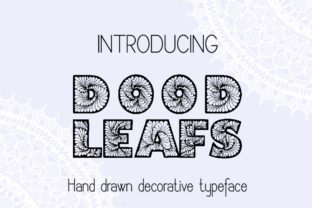
Doodleafs: A Hand-Drawn Font That Actually Fits Real Projects
If you’ve ever spent time scrolling through font libraries, you know the feeling. Everything starts to blur together. Serif, sans serif, script, display—most options look polished, predictable, and frankly, a little stiff. Then something like Doodleafs shows up, and you stop scrolling. It’s not trying to be perfect. It’s hand-drawn, uneven in all the right places, and available in two distinct versions. That slight imperfection is exactly what makes it useful in real situations.
Doodleafs is a hand-drawn font created by Eva Barabasne Olasz. Unlike many display fonts that mimic handwriting with mechanical precision, this one carries the warmth and rhythm of an actual pen moving across paper. It comes in two versions, which means you’re not locked into one mood. You can switch between them depending on the context, the audience, or just how you’re feeling that day. No fluff. Just a tool that works differently depending on where you put it.
Where Doodleafs Fits Naturally
Most fonts are designed for one primary use case—body text, headlines, branding. Doodleafs doesn’t lock itself into a single lane. Its hand-drawn character makes it flexible across personal, professional, creative, and commercial spaces. But flexibility only matters if you know where to apply it.
Social media content that doesn’t look templated
Social feeds are crowded. Everyone uses the same script fonts for quotes, the same bold sans for announcements. When you drop Doodleafs into a story background, a Reel title, or a carousel slide, the reaction is different. People pause. It looks like someone actually wrote it, not like another Canva template on autopilot.
For example, a freelance illustrator posting process videos can use Doodleafs for step labels. Instead of a sterile font, the hand-drawn letters match the organic feel of the artwork. A small coffee shop running an Instagram giveaway can write “WIN” in Doodleafs, and it feels less like an ad and more like a handwritten note taped to the counter.
Personal branding that actually reflects personality
Entrepreneurs and freelancers often struggle with looking professional without looking robotic. If you use a standard serif for your logo and website headers, you signal competence. But you also blend in. Doodleafs, especially the more playful version, adds a layer of approachability. It says “I make things by hand” or “I don’t take myself too seriously.”
A life coach using Doodleafs for their tagline on a business card creates a different first impression than Helvetica ever could. A photographer using it for watermark text or album titles keeps the visual identity tied to the craft, not the corporate side of the business.
Practical examples across different roles
Doodleafs doesn’t require you to be a designer. It works for everyday people who need words to feel human.
-
Teachers and educators – Classroom posters, worksheet titles, or digital lesson slides feel approachable. A science teacher labeling plant diagrams with Doodleafs keeps the material visually connected to nature themes. The hand-drawn quality reduces the formal distance between the content and the student.
-
Planners and journalers – Bullet journals, habit trackers, and goal pages look intentional when headers are written in a font that mimics handwriting. Doodleafs lets you create printable inserts or digital planner spreads that feel custom-made, even if you printed them from a PDF.
-
Marketers and small business owners – Flyers for local events, menus for pop-up markets, or email newsletter headers can carry a handcrafted vibe without hiring an illustrator. Doodleafs gives you that look in seconds, and because there are two versions, you can match the tone to the occasion. A casual community potluck uses the looser version. A product launch uses the tidier one.
-
Content creators and bloggers – Thumbnail text, quote overlays, and section dividers are natural spots for Doodleafs. It pairs well with clean sans serif body fonts, creating contrast. The viewer’s eye lands on the hand-drawn words first, then moves to the supporting text.
What to consider before using it
Doodleafs is not a body font. It’s display-oriented, which means using it for long paragraphs will tire the reader. The uneven strokes and playful shapes that make it charming in small doses become distracting at length. Reserve it for headlines, short phrases, emphasis, and decorative elements.
Also consider the two versions. One might have tighter letter spacing or slightly more consistent stroke weight. The other might feel looser and more organic. Preview both before committing. The version you choose affects readability from a distance, on small screens, and when paired with other fonts.
Another practical point: licensing. If you’re using Doodleafs for commercial work—logos, packaging, merchandise—check the license terms. Some hand-drawn fonts have restrictions on embedding or redistribution. Eva Barabasne Olasz’s work is typically straightforward, but always read the fine print so you don’t accidentally overstep.
Pairing Doodleafs with other fonts
One of the strongest ways to use Doodleafs is to let it lead while something neutral supports it. A clean sans like Montserrat, Open Sans, or even a subtle geometric font works well underneath. The contrast highlights the handmade quality.
A practical scenario: a wedding invitation suite. The couple’s names set in Doodleafs, event details in a simple serif. The hand-drawn lettering feels intimate, while the supporting type keeps the information readable. That same approach works for e-book covers, podcast titles, or even printed wall art.
Real outcomes from realistic use
When someone picks Doodleafs for a project, the outcome isn’t just “it looks nice.” The font changes how the audience perceives the effort behind the work. A restaurant menu using Doodleafs for dish names feels like a family-run place, not a chain. A small brand’s product labels feel artisanal. A student’s presentation feels human instead of corporate.
For the person creating the content, using Doodleafs can also speed up the design process. You don’t need to spend time hand-lettering individual words or hunting for organic alternatives. Two clicks and you’ve got the same handmade aesthetic without the hours.
Where not to use it
Doodleafs won’t work everywhere. Avoid it for legal documents, financial reports, technical manuals, or any context where clarity and uniformity are non-negotiable. Also, be careful with all-caps usage. Hand-drawn fonts often look awkward when forced into uppercase-only compositions, because the shapes weren’t designed for that kind of monotony.
On small screens—like phone notifications or mobile-first web headers—test readability. Some Doodleafs characters, especially in the looser version, might blur together at small sizes. Back it up with a fallback font in CSS or choose the version with cleaner spacing.
Why two versions matter more than you think
Most fonts give you one weight and one personality. Doodleafs gives you a choice. That’s not just a bonus feature. It solves a real dilemma: you want a hand-drawn look, but you need to match different contexts without switching to an entirely different typeface. Having two versions under one name keeps your brand consistent while allowing tonal shifts.
Imagine a children’s book author. They use the playful version for the title and chapter headings, then the cleaner version for activity pages or parent notes. Same font family, different energy. No need to reconcile two unrelated fonts.
Consider a wedding planner creating a series of social posts. The engagement announcement uses the looser, romantic version. The vendor spotlight uses the tidier version. Followers don’t notice the technical shift, but they sense the visual coherence.
A few final observations
Doodleafs works best when you treat it like a tool, not a gimmick. It’s not meant to shout “look at me, I’m quirky.” Instead, it whispers “someone made this.” That distinction matters for anyone who communicates through design—bloggers, business owners, creators, educators.
If you’re building a visual identity around warmth, craft, or approachability, Doodleafs can carry that weight. Just pair it thoughtfully, respect its limits, and let it do what hand-drawn type does best: remind people there’s a human behind the message.