Printers' Marks: The Hidden Signatures That Shaped the Early Printing Revolution
In the earliest days of printing with movable type, the printed page was more than just a vehicle for words—it was a statement of craft, identity, and trust. Long before the modern logo or the copyright page, printers needed a way to tell the world who had brought a book into being. That need gave rise to one of the most fascinating and visually rich traditions in publishing history: the printer's mark. This article explores the world of printers' marks—what they were, why they mattered, and how over 160 of these historic symbols capture the daring, influence, and ingenuity of early printers like Fust, Ratdolt, Manutius, and Caxton.
What Exactly Is a Printer's Mark?
A printer's mark, also known as a printer's device or colophon sign, is a symbolic emblem or image that early printers used to identify their work. It appeared on the final page or the title page of a book, serving as a signature of authenticity and ownership. Think of it as the 15th-century equivalent of a brand logo. These marks combined heraldic elements, religious imagery, botanical motifs, initials, and sometimes punning visual riddles that hinted at the printer's name or shop. They were compact, memorable, and carefully designed to convey authority, quality, and trust in a marketplace where printed books were still a relatively new and somewhat mysterious technology.
The Birth of a Need: Why Early Printers Needed Marks
When Johannes Gutenberg introduced movable type printing in the 1450s, the craft spread rapidly across Europe. But with rapid growth came confusion. Multiple printers might work in the same city, producing editions of the same Latin classics or religious texts. Without a clear identifier, readers and buyers had no way to tell which printer was behind a given book—and more importantly, which one they could trust.
Early printed books were expensive, handmade objects. A poorly produced edition with errors, bad inking, or flimsy binding reflected badly on the printer and could ruin a fledgling business. Printers therefore had a strong incentive to claim responsibility for their work. A mark allowed them to do just that. It also served as a kind of quality seal—a promise that the book had been produced with care by a known craftsman. Over time, some printer's marks became famous in their own right, instantly signaling reliability and prestige to buyers across Europe.
The Pioneers: Fust, Ratdolt, Manutius, Caxton, and More
The world of early printers' marks is populated by remarkable figures whose ambitions and talents helped shape the course of history. Let's look at a few of the most influential names and the marks they left behind.
Johann Fust
Johann Fust was a financier and business partner of Gutenberg. After a falling-out, Fust continued printing with his partner Peter Schoeffer. Fust's mark often featured a shield motif with stars or crosses, reflecting both heraldic tradition and religious piety. His output included the magnificent Gutenberg Bible and other early liturgical works. Fust's mark became a sign of quality in the earliest years of the industry, though his role in ousting Gutenberg remains controversial.
Erhard Ratdolt
Ratdolt, a German printer who worked primarily in Venice, was a true innovator in design. His printer's mark is one of the most beautiful and intricate of the early period, incorporating intricate floral patterns, ribbons, and heraldic elements. Ratdolt was also a pioneer of color printing, mathematical diagrams, and decorative initials. His mark is a perfect example of how early printers used visual beauty to elevate their brand identity.
Aldus Manutius
Perhaps the most famous printer of the Renaissance, Aldus Manutius of Venice created a printer's mark that became legendary: the dolphin twined around an anchor. Derived from a classical Roman coin symbol meaning "hurry slowly" (festina lente), this mark embodied the ideal of diligent, thoughtful work. Manutius was a scholar-printer who produced affordable editions of Greek and Latin classics, revolutionizing access to ancient knowledge. His mark was later adopted by many other printers and even appears in modern publishing logos today.
William Caxton
Caxton introduced printing to England in the 1470s, and his printer's mark is one of the most recognizable of the era. It features his initials "W.C." intertwined with geometric lines, often accompanied by a merchant's mark resembling a figure 4 or a cross. Caxton's mark was both personal and professional, reflecting his dual roles as printer and merchant. He printed over 100 works, many in English, and his mark became a symbol of English literary culture.
Other Notable Names
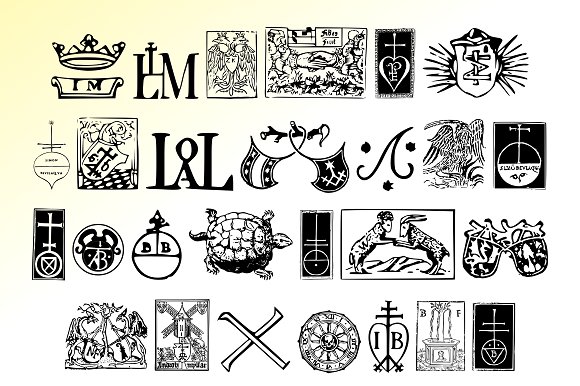
The font of marks described here includes over 160 devices from dozens of other influential printers spanning the first century of printing. Among them are Johann Amerbach (founder of Basel's printing dynasty), Anton Koberger (who ran one of Europe's largest printing operations in Nuremberg), Henri Estienne (a scholarly printer in Paris), and many others. Some of these printers were imprisoned for their controversial or heretical works. Others helped fuel the Reformation by enabling broad distribution of theological pamphlets. Still others simply made the classics accessible to a growing middle class. All of them, however, understood that a distinctive mark was essential to building a reputation in a competitive and rapidly evolving marketplace.
Why Printers' Marks Matter for Understanding History
Printers' marks are far more than decorative curiosities. They are primary sources that tell us about the values, ambitions, and networks of the early modern world. A careful study of marks reveals patterns of collaboration, migration, and competition among printers. It shows how printers positioned themselves in relation to religious and political authorities. It also demonstrates how visual branding emerged long before modern marketing departments existed.
Moreover, these marks connect directly to the larger story of how printing changed the world. By enabling the fast, accurate reproduction of texts, movable type allowed ideas to travel farther and faster than ever before. The Protestant Reformation, the Scientific Revolution, and the spread of humanist education all depended on printed books. Printers were not mere technicians; they were cultural gatekeepers and entrepreneurs who helped shape public discourse. Their marks are the signatures of that influence.
Understanding the Symbolism in Printer's Marks
The imagery in printer's marks is rich with meaning. Common motifs and their intended messages include:
- Religious symbols (crosses, saints, chalices, doves) – signaled piety and the printer's role in disseminating sacred texts.
- Heraldic shields and crests – communicated status, tradition, and family legacy.
- Puns and wordplay – many marks incorporated visual puns on the printer's name (e.g., a bear for Bernhard, a star for Stella).
- Classical and mythological figures – reflected Renaissance humanism and classical learning.
- Globes and compasses – suggested reach, exploration, and intellectual breadth.
- Mottoes and Latin phrases – offered wisdom, warnings, or promises to the reader.
For instance, the famous dolphin-and-anchor of Manutius was not merely decorative—it was a deliberate philosophical statement about the balance of speed and caution in scholarly work. Understanding these symbols helps us read early books the way their original audiences did.
Printers' Marks in Modern Life and Business
Though we no longer see printer's marks on books in the same way, their legacy is everywhere in modern design and branding. The concept of a simple, memorable visual mark that identifies a creator or publisher is the direct ancestor of the modern logo. Publishing houses, software companies, and creative studios all rely on the same principle: a small symbol can carry enormous meaning and trust.
In addition, the study of printer's marks has found new relevance in fields like graphic design, typography, branding history, and digital publishing. Designers today often look back at these early marks for inspiration, learning how to compress complex ideas into a single, elegant visual. The constraints that early printers faced—limited color, small space, and the need for instant recognition—are remarkably similar to the challenges of modern logo design.
For bibliophiles, collectors, and rare book enthusiasts, printer's marks remain a key tool for identifying editions, dating books, and tracing the provenance of historical copies. A mark can reveal which printing workshop produced a book, in which city, and sometimes during which period of the printer's career. This makes marks invaluable for scholarly attribution and for understanding the interconnected networks of the early printing world.
Common Misunderstandings About Printer's Marks
One common assumption is that printer's marks are the same as watermarks. They are not. Watermarks are identification marks created by papermakers in the paper itself, visible only when held to light. Printer's marks are printed images that are part of the book's design. Another misunderstanding is that printer's marks were purely decorative. While they certainly had aesthetic appeal, their primary function was practical: identification, quality assurance, and brand building.
Some also assume that all early printers used marks. In reality, while many did, some printers never adopted a mark, and others used multiple variations over their careers. The presence or absence of a mark can itself be a clue to a printer's business practices, personality, or market position. Finally, it's a mistake to think that a printer's mark was always placed at the end of the book. Early marks appeared in various locations—title pages, final leaves, and occasionally inside the text itself—depending on local tradition and the printer's preference.
The Enduring Appeal of a Small Mark
There is something deeply human about the impulse to leave a signature. The early printers who created these marks were not just making a living; they were making a statement. They were saying, "I was here. I made this. I stand behind it." In an age before trademarks, patents, and brand registration, the printer's mark was a voluntary act of accountability. It was also an act of pride. Many of these marks survive today because they were carefully integrated into some of the most beautiful books ever printed.
When we look at a printer's mark from the 1470s or 1490s, we are looking at the visual identity of a person who helped build the modern information age. The marks of Fust, Ratdolt, Manutius, and Caxton are not just symbols—they are portraits of ambition, skill, and vision. And for anyone interested in the history of books, design, or communication, they offer a rich and rewarding field of study.
Conclusion: More Than Just an Old Emblem
Printers' marks are a fascinating intersection of art, commerce, and history. They emerged from a practical need in the early days of printing and evolved into a sophisticated form of visual branding. Over 160 of these marks, representing printers from across Europe, survive in the font described at the beginning of this article. Each one tells a story about the printer who used it, the books it adorned, and the world that printing was helping to transform.
For the modern reader, understanding printer's marks opens a window into the early modern period and the individuals who made the explosion of printed knowledge possible. Whether you're a designer looking for inspiration, a historian seeking authenticity, or simply a curious reader fascinated by how our world came to be, the printer's mark is a small but powerful place to start. The next time you pick up an old book—or even think about a modern logo—remember the humble, clever, and enduring legacy of those first 160 marks and the printers who dared to put their names on the page.