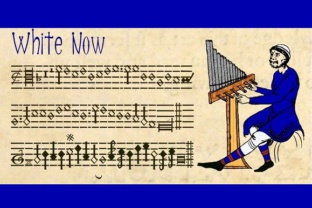
Reviving History: The White Now Font and the Lost Art of Single-Impression Music Printing
In 1528, Pierre Attaignant changed the course of music history from a printing shop in Paris. While Ottaviano Petrucci had already pioneered music printing using a cumbersome triple-impression method—requiring separate passes for staves, notes, and text—Attaignant streamlined everything into a single press run. His innovation remained the dominant method for printing music until nearly the end of the 17th century, shaping how composers, performers, and publishers shared musical ideas across Europe. Today, a specialized typeface called White Now brings that same historical printing method back to life, allowing modern users to recreate the notation of that era with remarkable authenticity.
Understanding what White Now does requires looking closely at the limitations and strengths of Attaignant's technique. His single-impression method could only produce one line of music per staff at a time. Barlines, as we know them today, did not exist in early uses of this system. Instead, multiple staves were aligned by careful spacing and the eventual adoption of barlines as a common alignment tool. This system persisted for nearly two centuries, precisely because it was fast, cost-effective, and reproducible at scale. White Now is designed to replicate the exact look and feel of that notation, drawing heavily from an exemplar printed by the London-based printer Snodham. It also accommodates the even earlier black notation, giving users access to an even broader historical range.
What Makes White Now Different from Modern Music Fonts
Most music notation software today relies on fonts derived from 18th- and 19th-century engraving traditions. Notes are round, stems are uniform, and barlines are thick and consistent. The notation that White Now emulates is visibly different. Noteheads are diamond-shaped or lozenge-like, stems are lighter and often slightly angled, and the overall impression is one of hand-drawn elegance rather than mechanical precision. This is not a font for writing contemporary pop charts or orchestral scores. It is a specialized tool for historical authenticity, educational projects, and niche publishing where period-correct appearance matters.
The font handles both white mensural notation (the dominant style from the 15th to 17th centuries) and the earlier black notation that preceded it. This dual capability is rare. Most historical typefaces focus on one period or the other. White Now bridges that gap, making it useful for anyone working with music from the late medieval period through the Renaissance and into the early Baroque. If you are transcribing a Josquin motet, a Dowland ayre, or a piece from the Parthenia collection, this font gives you the visual vocabulary to match the original printed sources.
The Practical Workflow for Typographers and Engravers
For those accustomed to modern scoring software like Finale, Sibelius, or Dorico, working with White Now requires a shift in mindset. This font is not a plug-in that automates notation layout. It is a typeface designed for use in desktop publishing applications, such as Adobe InDesign, Affinity Publisher, or even word processors with careful manual placement. The user places individual note glyphs, rests, clefs, and accidentals one by one, aligning them to a scanned or drawn staff. This is a deliberate, hands-on process that mirrors the work of 16th-century compositors. For small projects—a single page of a historical facsimile, a title page for a recital program, or a scholarly article excerpt—this workflow is entirely reasonable. For full-length scores, it is labor-intensive but yields stunning results.
One practical benefit of White Now is its attention to spacing and optical balance. Historical single-impression type was cast with the note and its surrounding space as one piece, meaning that note spacing was determined by the width of each sort. The font replicates this logic, giving the final output a rhythmically organic feel. Notes do not sit at mathematically equal distances; they sit at distances that reflect the original casting. This subtle irregularity is precisely what makes the output look genuine rather than like a modern imitation.
Who Benefits from Using White Now
The audience for White Now is narrower than that for a general-purpose music font, but within that niche, the value is considerable. Musicologists and historical performers are the most obvious users. When preparing editions for publication—whether in a journal, a critical edition, or a performance score intended for early music ensembles—the visual presentation reinforces the scholarly message. A piece printed in White Now signals to the reader that this is not a modernized arrangement but a faithful transcription respecting original notation conventions.
Early music enthusiasts and amateurs also find the font rewarding. If you maintain a blog about Renaissance lute music, produce facsimile-style worksheets for a viol consort, or design concert programs for a group like The Tallis Scholars, White Now adds a layer of authenticity that plain modern fonts cannot achieve. It is also used by calligraphers, book artists, and designers creating limited-edition prints or artist books centered on historical music topics.
Scenarios and Recommendations
Let me offer a few concrete scenarios. Suppose you are preparing a critical edition of a Thomas Morley ballett for a musicology conference. The source material is a 1598 print from the London firm of Thomas Snodham. Using White Now allows you to present the music in a typeface that closely matches the original, while still providing a modern clef and incipit. Your readers immediately recognize the historical context. Another scenario: you run a small press specializing in early music facsimiles. You want to produce a modern reprint of a 1623 madrigal collection, but the original type is unavailable. White Now lets you reconstruct the page with type that is not just historically inspired but structurally consistent with the single-impression method.
For those considering adoption, here are a few practical considerations. First, the learning curve is real if you have never worked with manual typographic layout. Expect to spend time adjusting kerning and vertical alignment. Second, the font works best at larger point sizes—typically 14 pt and above—to preserve the delicate stroke details. Third, pair it with a complementary text face that matches the period, such as a Garamond or a Jenson. The combination creates a cohesive page aesthetic. Finally, test print on a paper stock that has a slight tooth or cream tone. High-gloss paper looks anachronistic and diminishes the effect.
The Value of Historical Accuracy in a Digital Age
There is a deeper reason to use a font like White Now beyond mere nostalgia. When we see music in its original typographic form, we are reminded that notation is not a neutral container for sound. It is a material artifact shaped by technology, economics, and craft. The single-impression method produced a particular kind of page—one where the spacing, the weight of the lines, and the relationship between text and music were all determined by the realities of movable type. By using White Now, we engage with that material history in a way that a modern, uniform font obscures. It changes how we read the music, making us more attentive to articulation, phrasing, and the physical constraints that composers and printers navigated.
This is not just an academic point. Performers who work from facsimile editions often report that the visual cues of historical notation influence their interpretation. The slightly irregular spacing of notes in White Now can suggest a more flexible, speech-like rhythm than the grid-like precision of modern engraving. The absence of heavy barlines reduces the sense of metronomic rigidity. In this sense, the font is not just a visual tool but an interpretive one.
Considerations Before Committing to White Now
Before you invest time in White Now, consider your project goals. If you need a quick, functional score for a modern ensemble, this font is likely overkill. It will slow down your workflow and may confuse musicians unfamiliar with historical notation. If, however, your project requires that the visual presentation match the historical source, or if you are creating material for an audience that values authenticity, then White Now is unmatched.
Also consider compatibility. The font includes the necessary characters for mensural notation—breves, semibreves, minims, semiminims, fusa, and semifusa—along with ligatures and coloration marks. But it does not include modern dynamics, articulations, or expression marks. You must either omit those or add them from another font, which requires care to maintain visual coherence. For most historical work, this is not a problem, because those markings are anachronistic to the period anyway.
Final Observations
White Now is a remarkable bridge between 16th-century printing technology and 21st-century digital typography. It honors the single-impression method of Pierre Attaignant and the work of Thomas Snodham, while providing a practical tool for contemporary musicologists, editors, performers, and designers. The font does not try to modernize the past; it tries to reproduce it faithfully, including the quirks and constraints that gave early music printing its distinctive character. For anyone serious about historical music presentation, it is an essential addition to the toolkit. The method that served publishers for nearly two centuries may be obsolete as a technology, but its aesthetic and cultural value endures, now preserved in a form that anyone can use.