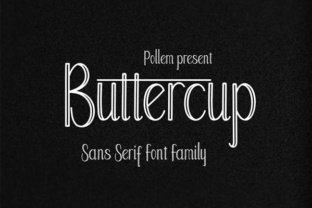
The Buttercup Font Family: Small Sans Serif Design for Modern Communication
Typography shapes how we read, interpret, and trust information. Among the many typefaces available, small sans serif families hold a distinct place because they combine clarity with economy of space. The Buttercup font family — a compact sans serif set comprising Buttercup, Buttercup 1, and Buttercup Line — offers a focused toolset for designers, writers, and communicators who need precision at smaller sizes without sacrificing character. Understanding what this family provides, how it works across different contexts, and where it fits best can help a wide range of professionals and hobbyists make more informed typographic choices.
Where Small Sans Serif Typefaces Meet Real Needs
The demand for small-scale typography has grown steadily alongside the proliferation of mobile interfaces, data dashboards, compact publications, and space-constrained branding assets. A small sans serif font family like Buttercup addresses a specific tension: the need to maintain readability at tiny point sizes while preserving a clean, modern aesthetic. Serif typefaces, with their decorative strokes, often lose legibility when scaled down, especially on screens. Sans serif fonts, particularly those designed with generous x-heights and open counters, tend to perform better. Buttercup belongs to this category, but it goes a step further by offering multiple variants — the base Buttercup, the refined Buttercup 1, and the distinctive Buttercup Line — each tuned for slightly different visual demands.
Educators preparing printed handouts, researchers laying out dense figures, and business owners designing product labels all encounter the same challenge: conveying information clearly in a small space. A font family that maintains consistency across its cuts reduces cognitive load for the reader and simplifies workflow for the creator. This is where Buttercup’s design philosophy becomes practically relevant.
Anatomy of the Buttercup Family: Three Variants, One Voice
A font family with multiple members must balance uniformity with purpose. Buttercup achieves this through three distinct styles that share underlying structural DNA. The base Buttercup character set is straightforward: clean strokes, minimal stroke contrast, and upright letterforms that feel neutral yet warm. It works well for body text in narrow columns or for UI labels where every pixel counts.
Buttercup 1 introduces subtle refinements. The spacing is slightly tighter, the curves a little more resolved, and the overall impression is one of increased density. This variant suits situations where space is at a premium but readability cannot be compromised — for example, in financial tables, technical diagrams, or multilingual signage where characters must remain distinct even at small sizes. The design choices in Buttercup 1 reflect an understanding that compactness should not come at the cost of clarity.
Buttercup Line takes a different approach. It emphasizes horizontal flow, with elongated strokes and a slightly narrower set width. This variant is particularly effective for horizontal layouts: timelines, navigation menus, taglines, or any context where the eye should travel smoothly along a line of text. Unlike condensed families that compress letters uniformly, Buttercup Line maintains proportional integrity, so words remain recognizable rather than squashed. Together, the three variants offer a toolkit rather than a single typeface.
Practical Advantages Across Professional Contexts
Typography is never just about aesthetics — it directly affects comprehension, retention, and user trust. Professionals from different fields can leverage the Buttercup family for specific, tangible benefits.
For Designers and Creators
When building a user interface, every element competes for attention. A small sans serif like Buttercup helps designers create hierarchies without resorting to extreme size differences. The family’s consistent stroke weight and moderate contrast make it suitable for captions, tooltips, and secondary information that should remain legible but not intrusive. Designers working on responsive layouts appreciate that Buttercup retains its identity across screen resolutions, from high-DPI monitors to standard laptop displays.
For Business Owners and Marketers
Branding materials often need to convey professionalism in limited real estate — business cards, brochure footnotes, invoice details. Buttercup’s neutral tone pairs well with both conservative and contemporary brand identities. The availability of Buttercup 1 for dense data presentation means that annual reports and product specifications can look cohesive without requiring multiple font licenses. For small business owners managing their own communications, a single family that handles body text, captions, and accent lines simplifies their typographic system.
For Educators and Researchers
Academic posters, conference handouts, and online course materials demand clarity above all. Buttercup Line, with its horizontal emphasis, works well for figure labels and axis titles where space along the x-axis is plentiful but vertical space is tight. Educators preparing worksheets for younger readers find that the family’s straightforward letterforms reduce ambiguity — lowercase ‘a’ and ‘g’ follow traditional shapes rather than overly stylized alternatives, which supports emerging literacy.
For Hobbyists and Enthusiasts
Whether designing a personal zine, formatting a recipe collection, or building a simple website, hobbyists benefit from a font family that behaves predictably. Buttercup’s availability in multiple cuts means one download can cover a range of uses without the need to mix different typefaces. The family’s small footprint (both in file size and visual weight) also suits projects where speed and simplicity matter more than elaborate typographic flourishes.
Key Characteristics That Define Buttercup’s Performance
Beyond the obvious fact of being small and sans serif, several measurable traits make Buttercup a practical choice for everyday work.
- X-height relative to cap height: Buttercup features a generous x-height, which directly aids legibility at small point sizes. The lowercase letters are tall relative to the uppercase, so the word shape remains recognizable even when the font size drops below 8pt.
- Counter openness: Enclosed spaces inside letters like ‘o’, ‘e’, and ‘a’ are wide enough to avoid filling in at small sizes or on coarse paper. This is a common weakness in condensed sans serifs, and Buttercup’s design explicitly addresses it.
- Stroke modulation: While the family is largely monolinear, subtle variations in stroke weight occur at junctions to prevent dark spots. This optical refinement helps the text read evenly across a block of copy.
- Spacing consistency: The default tracking in Buttercup and Buttercup 1 is calibrated for small sizes, reducing the need for manual kerning adjustments in layout software. Buttercup Line is slightly wider, which compensates for the compressed set width.
These characteristics translate directly into real-world performance: less time spent tweaking spacing, fewer issues with legibility during print runs, and a more consistent reading experience for the audience.
Considerations Before Adopting a Small Sans Serif Family
No typeface is universally optimal, and Buttercup is no exception. Understanding its limitations helps users deploy it effectively.
Size range: Buttercup variants are optimized for sizes between 6pt and 14pt. Above 18pt, the simplicity of the forms can feel underwhelming compared to display-oriented typefaces. For headlines or large titles, pairing Buttercup with a contrasting display font is advisable. The family’s neutral character means it plays well with both slab serifs and geometric sans serifs as companion fonts.
Language support: The core character set covers Western European languages, but users working with Central European, Cyrillic, or extended Latin scripts should verify glyph coverage before committing. Small families sometimes limit diacritic handling, which can affect multilingual projects.
Screen rendering at very small sizes: While Buttercup performs well on modern screens, legacy displays with lower resolution may cause hinting artifacts. Testing on target devices is recommended for digital products that will be viewed on older hardware. The family’s generous x-height helps, but hinting quality ultimately depends on the foundry’s implementation.
Print substrate: On uncoated paper or newsprint, the thin strokes of Buttercup Line may appear lighter than intended. A slight weight increase via stroke adjustment in the layout software can compensate. Buttercup 1, with its denser spacing, tends to hold up better on absorbent papers.
Integration into Existing Workflows
Adopting a new font family often feels disruptive, but Buttercup’s structure supports gradual integration. A design team might begin by using Buttercup for UI captions and secondary text, then expand to Buttercup 1 for data tables, and finally introduce Buttercup Line for horizontal navigation elements. Because the three variants share a common skeleton, mixing them within a single project does not create visual friction.
For web developers, loading the entire family via a single stylesheet entry simplifies maintenance. The consistent metrics across variants mean that line-height adjustments and margin calculations remain stable even when switching between Buttercup, Buttercup 1, and Buttercup Line. This predictability reduces the back-and-forth often associated with font swap experiments in CSS.
Print publishers working with InDesign or similar software will find that the family’s kerning tables are well-tuned for typical copy sizes. Manual kerning pairs in large text blocks become unnecessary, saving time during the proofing stage. The family also supports standard OpenType features such as ligatures and tabular figures, which adds flexibility for financial or technical documents.
Observations from Working with Small Sans Serifs
Over several projects where compact typography was essential, patterns emerge that reinforce the value of a dedicated small sans serif family like Buttercup. In one instance, a university research group needed to fit a complex flow diagram into a single A4 poster. Using Buttercup 1 at 7pt for node labels allowed the diagram to remain readable while staying within the size constraint. The same poster with a general-purpose sans serif required either reducing the diagram scale (losing detail) or switching to a condensed font that distorted the character shapes. Buttercup provided a middle path: compact but still clear.
Another example comes from a small e-commerce brand that redesigned its product packaging. The ingredient lists and net weight information had to be legible on bottles with limited label area. Using Buttercup Line for the horizontal ingredient row and Buttercup for the net weight ensured that all mandatory information was present without requiring a magnifying glass. Customers responded positively to the clean look, and regulatory compliance was met without extra design iterations.
These observations highlight a simple truth: when a font family is designed with a specific size range in mind, it performs better than a general-purpose typeface that is arbitrarily scaled down. Buttercup’s existence as a small sans serif family reflects a deliberate focus rather than a compromise.
Adapting to Changing Typographic Landscapes
Typography is not static. Screen resolutions, reading habits, and design trends evolve. Small sans serif families like Buttercup are well-positioned to remain relevant because they address a fundamental need: legibility under constraint. As interfaces become more information-dense and attention spans remain fragmented, the ability to present text cleanly at small sizes will only grow in importance. Variable font technology may eventually offer even finer control, but the core principles that Buttercup embodies — consistent color, open counters, generous x-height, and purposeful spacing — will continue to guide effective type design.
For users building long-term design systems, choosing a family that includes multiple cuts for different roles reduces the risk of fragmentation. The Buttercup family’s structure — base, refined, and linear — mirrors common document hierarchies: body, caption, and direction. This alignment with real editorial needs makes it a functional choice rather than merely a stylistic one.
Educators teaching typography fundamentals can use Buttercup as a case study in how small sans serifs differ from display or text faces. Students quickly see that reducing point size does not automatically destroy readability if the typeface is designed for that range. Business owners evaluating font investments appreciate that a single family can serve multiple roles, lowering both cost and complexity.
Making the Most of a Small Sans Serif Tool
Working effectively with Buttercup means understanding its strengths and adjusting expectations accordingly. Use Buttercup for general body copy in narrow contexts, especially where space is limited and a neutral tone is desired. Reach for Buttercup 1 when the text includes numbers, abbreviations, or dense information that must remain distinct. Apply Buttercup Line to horizontal elements — menus, captions, headers — where the visual flow should guide the eye along a path.
Pairing recommendations are straightforward: the family’s neutrality allows it to support bolder headline faces without conflict. A sturdy slab serif or a geometric sans with more pronounced character works well for headings at large sizes. In digital contexts, maintaining a minimum contrast ratio between text and background is essential, particularly at small sizes. A light gray on white may look elegant but can reduce legibility when using Buttercup at 8pt on a mobile screen.
Finally, testing remains the most reliable guide. Print a sample of your project using each variant at the intended size, on the intended substrate, and under the intended lighting. For screen projects, run readability tests with actual users rather than relying solely on design software previews. Small differences in spacing or stroke weight become magnified at small sizes, and real-world feedback reveals issues that static mockups miss.
The Buttercup font family, with its three complementary cuts, represents a thoughtful response to a persistent typographic challenge. By focusing on the practical realities of small-scale communication — clarity, consistency, and economy — it serves a broad audience without pretension. Whether you are labeling a diagram, formatting a footer, or building a responsive interface, understanding how to deploy these small sans serif variants effectively can elevate your work and improve the experience of everyone who reads it.